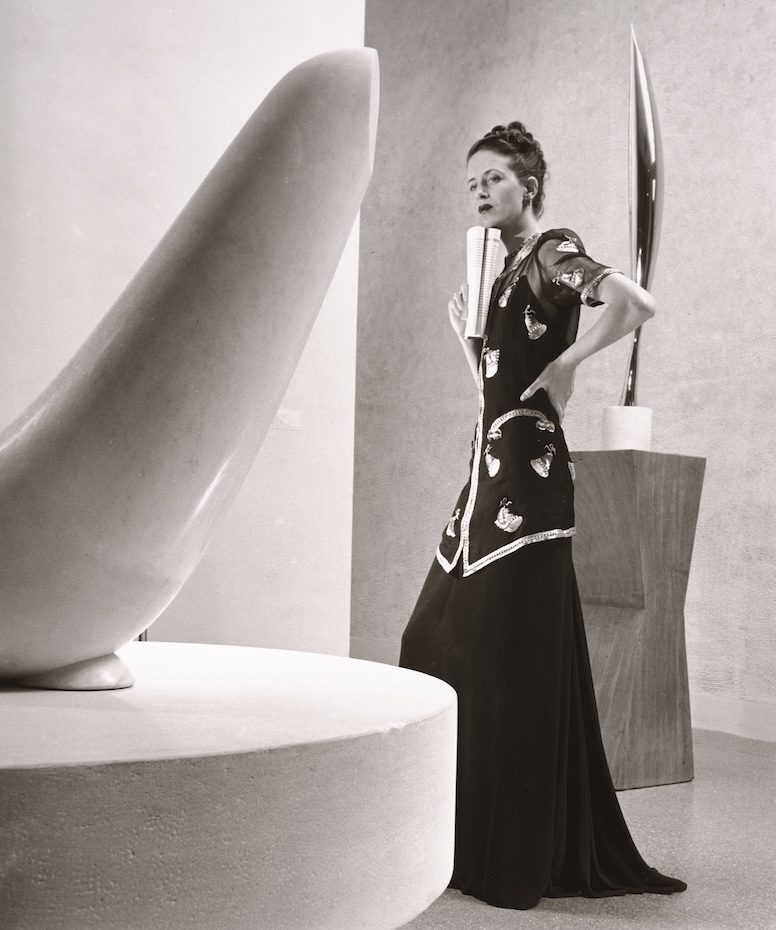
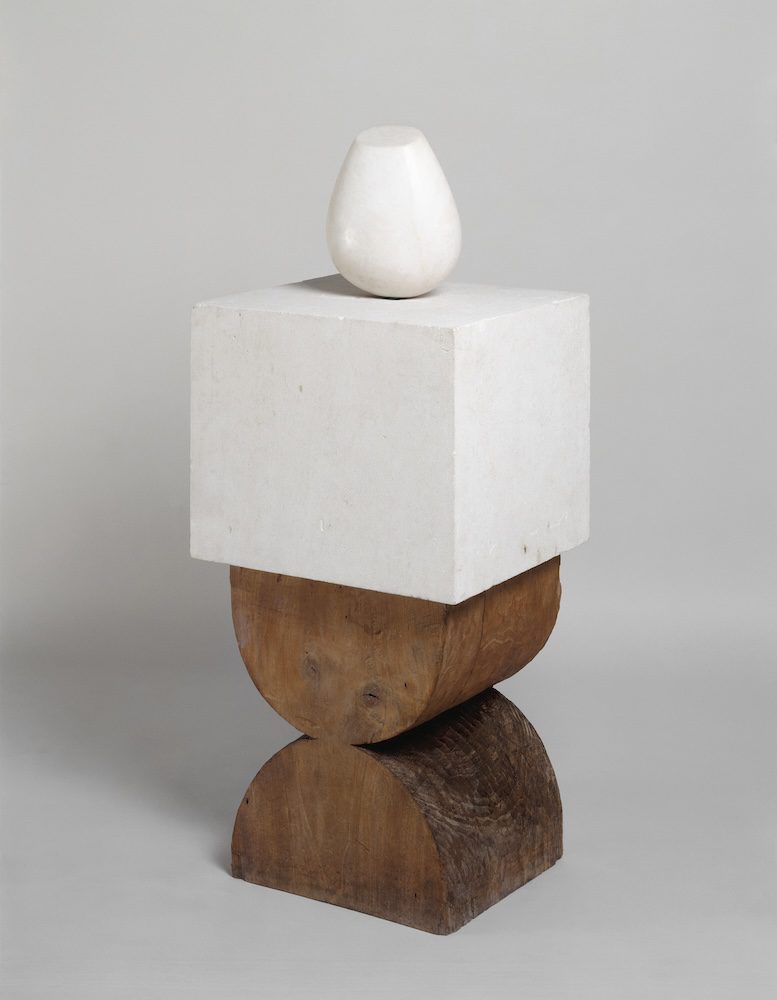
February 19th will be the 150th anniversary of the birth of Constantin Brancusi, the pioneer of contemporary sculpture. Scala is pleased to guide you through the life of the artist and 5 prestigious works from international museums which have chosen us as their official agent: the Metropolitan Museum of Art, the Philadelphia Museum of Art, the Art Institute of Chicago, the Centre Pompidou, and the Solomon R. Guggenheim Museum.
On February 19, 1876, Constantin Brancusi, was born in Hobița, Romania, and was destined to revolutionize modern sculpture more than any other sculptor. His artistic journey represents an extraordinary voyage from tradition to modernity, from the Romanian countryside to Parisian salons, from naturalistic representation to the most essential abstraction.
Brancusi arrived in Paris in 1904, after walking most of the way across Europe. In the French capital, he briefly worked in Auguste Rodin, but soon distanced himself from the master, declaring that “nothing can grow in the shadow of a great tree.” This break marked the beginning of a personal quest that would forever change the face of 20th-century sculpture.
His artistic philosophy was founded on the search for essence, on reducing form to its purest core. Brancusi polished, filed, and buffed his materials until achieving surfaces of extraordinary perfection, transforming marble, bronze, and wood into forms that seem to capture the eternal. He died in Paris on March 16, 1957, leaving a legacy that continues to inspire generations of artists.
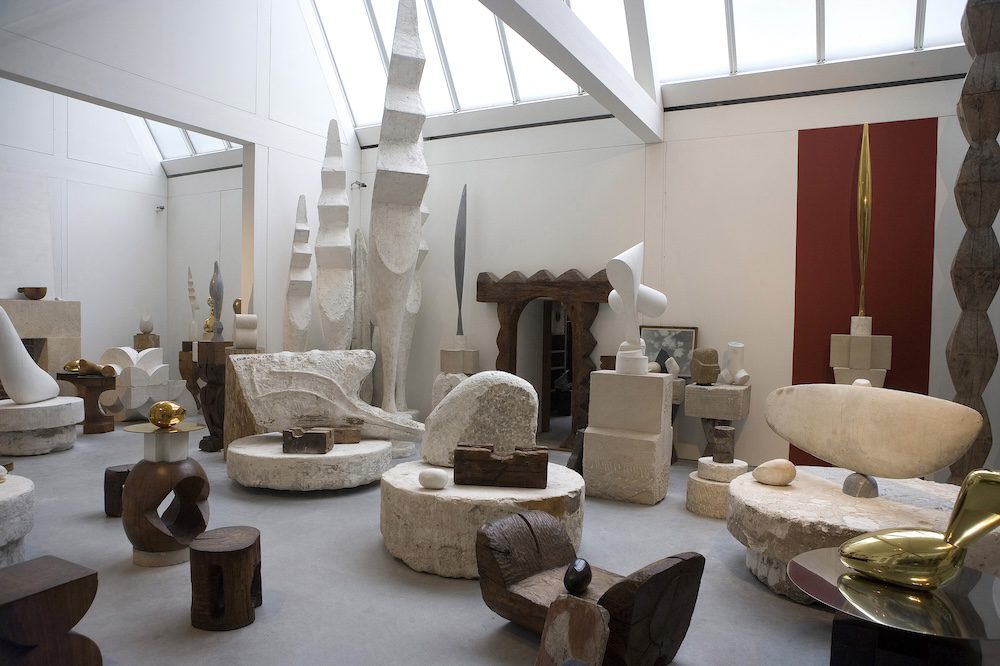
From 1916 until his death, Brancusi worked in various ateliers located first at number 8 and then at number 11 Impasse Ronsin, in Paris’s 15th arrondissement. These spaces were not mere workplaces but an integral part of his artistic vision. The artist initially used two studios, later knocking down the dividing walls to create larger environments for displaying his works. In 1936 and 1941, he added two more adjacent spaces, dedicated to works in progress and tools.
For Brancusi, the studio was itself the work. Beginning in the 1920s, he opened the doors of his atelier, transforming it into a kind of showroom where sculptures were arranged in “mobile groups” that created dynamic spatial relationships among the works. This meticulous attention to the arrangement of sculptures became so central to his artistic practice that, toward the end of his life, he completely abandoned the production of new works to dedicate himself exclusively to arranging existing ones within the studio.
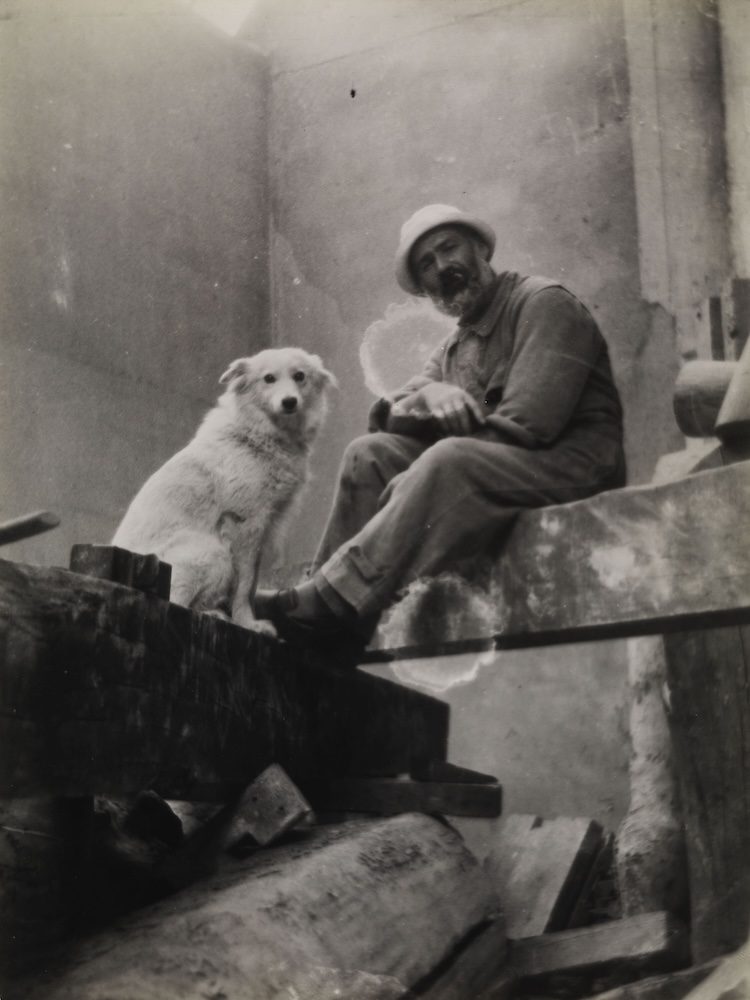
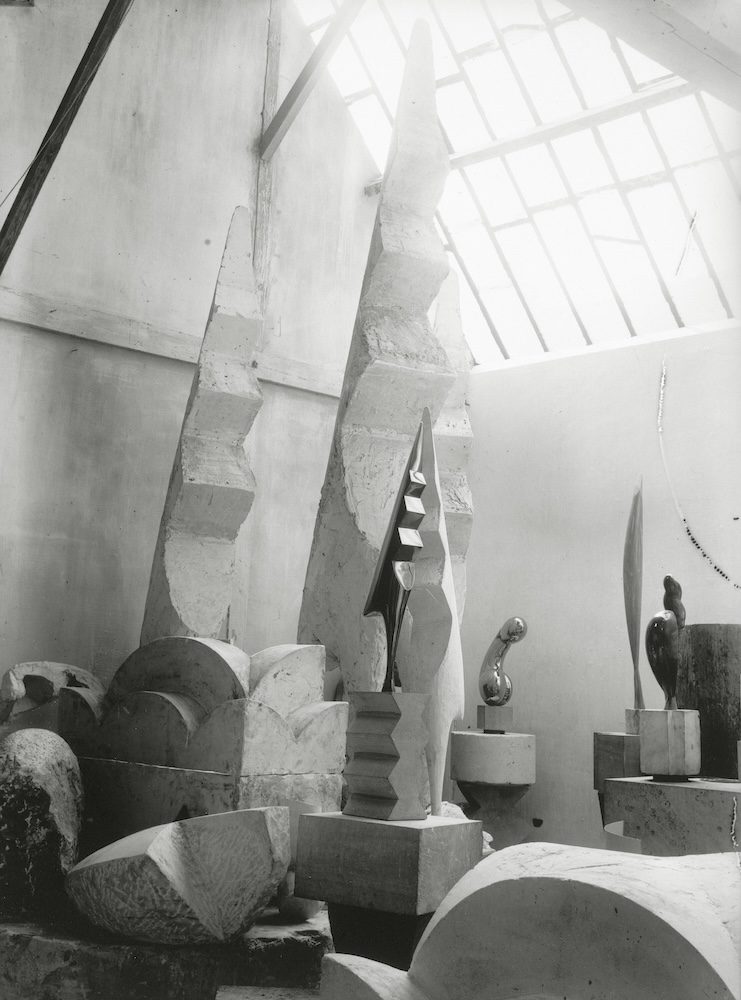
In his 1956 will, Brancusi left the entire atelier to the French State on the condition that it if moved it would be reassembled and rebuilt exactly as it was at the time of his death. This extraordinary donation included finished works, sketches, furniture, tools, and the artist’s personal library and record collection.
Since 1997 the reconstructed atelier has been located in the plaza of the Centre Pompidou. Architect Renzo Piano designed this dedicated museum space. The reconstruction faithfully respected the volumetric articulation and lighting system of the original spaces, recreating the unique atmosphere of the artist’s workshop. Visitors enter through a small walled garden, descending a few steps that lead into the museum space.
The permanent collection comprises 137 sculptures, 87 original pedestals, 41 drawings, 2 paintings, and over 1,600 photographic plates and original prints created by the artist. This extraordinary corpus testifies not only to Brancusi’s sculptural genius but also to his photographic sensibility: the artist obsessively documented his works and their installation, aware of the importance of light and spatial arrangement.
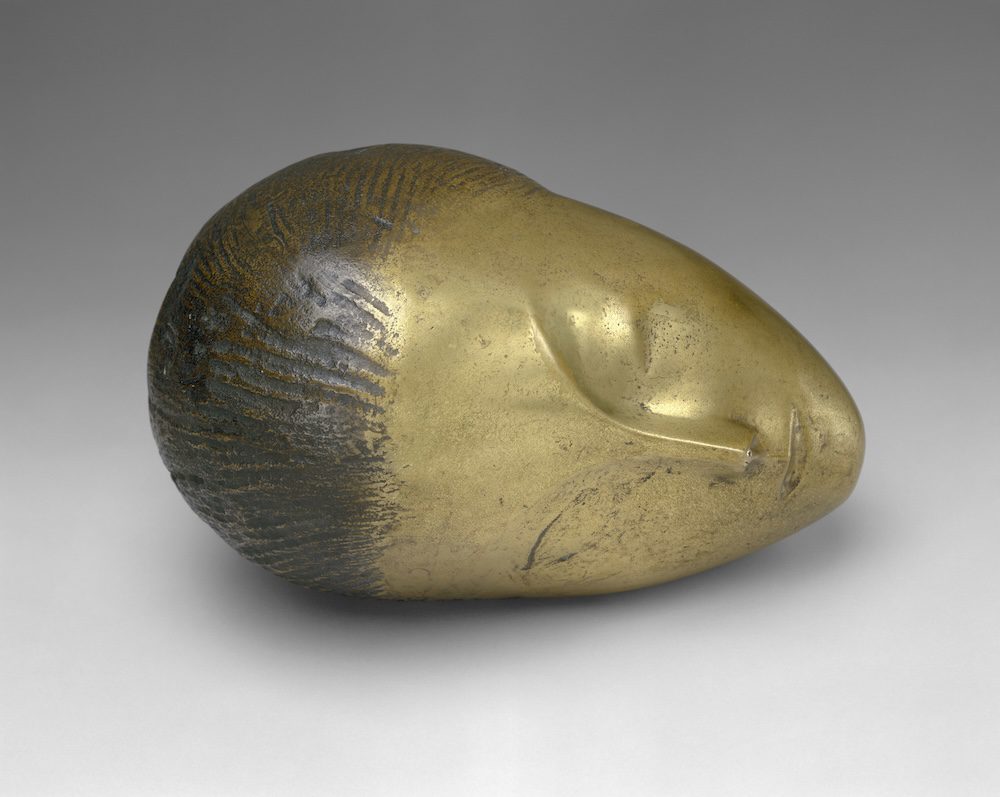
With this polished bronze sculpture, Brancusi takes one of his first decisive steps toward abstraction. The ovoid head, reduced to its essential form, represents the sleeping muse with revolutionary formal synthesis. The closed eyelids, barely suggested, and the facial features stylized to the maximum create an image of profound serenity. The polished surface reflects light in such a way as to make the work seem almost immaterial, suspended between dream and reality. This work marks the definitive departure from nineteenth-century descriptive sculpture and the opening toward a new concept of sculptural space.
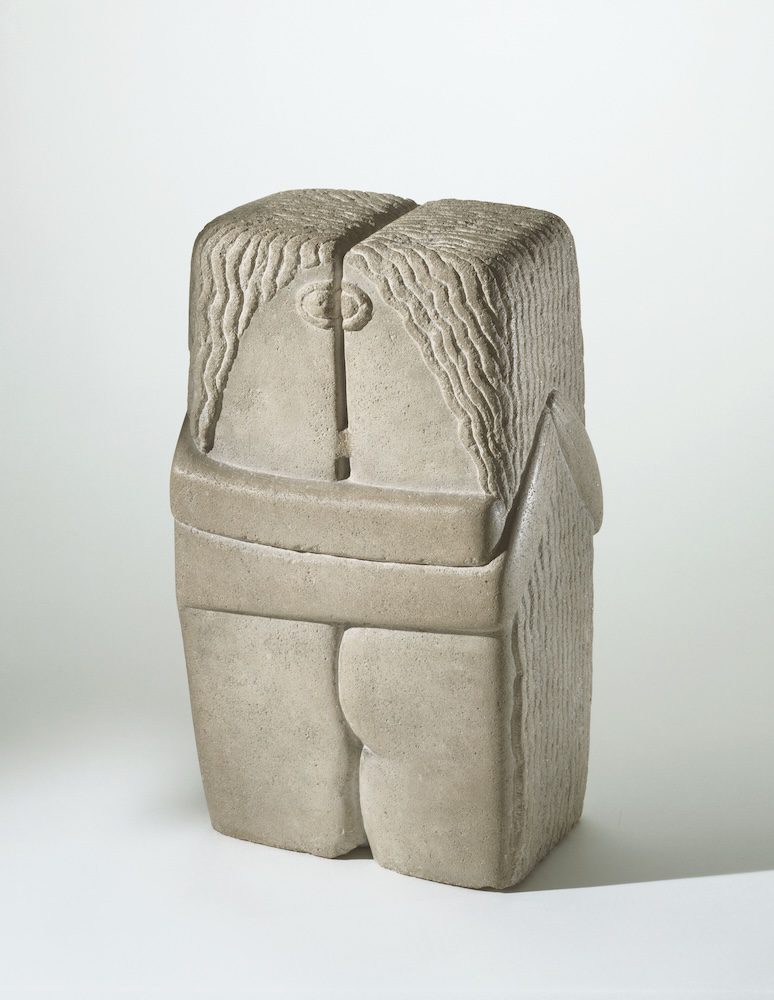
In sharp contrast to Rodin’s celebrated kiss, laden with pathos and drama, Brancusi proposes a vision of the loving embrace marked by geometric synthesis and primordial unity. The two lovers are depicted as a single block of limestone, their bodies fused in an eternal embrace. The circular eyes, the clasping arms, and the stylized hair are barely incised on the surface, suggesting rather than describing. The strength of this work lies in its ability to express total union through formal reduction, demonstrating that essentiality can be more eloquent than meticulous description.
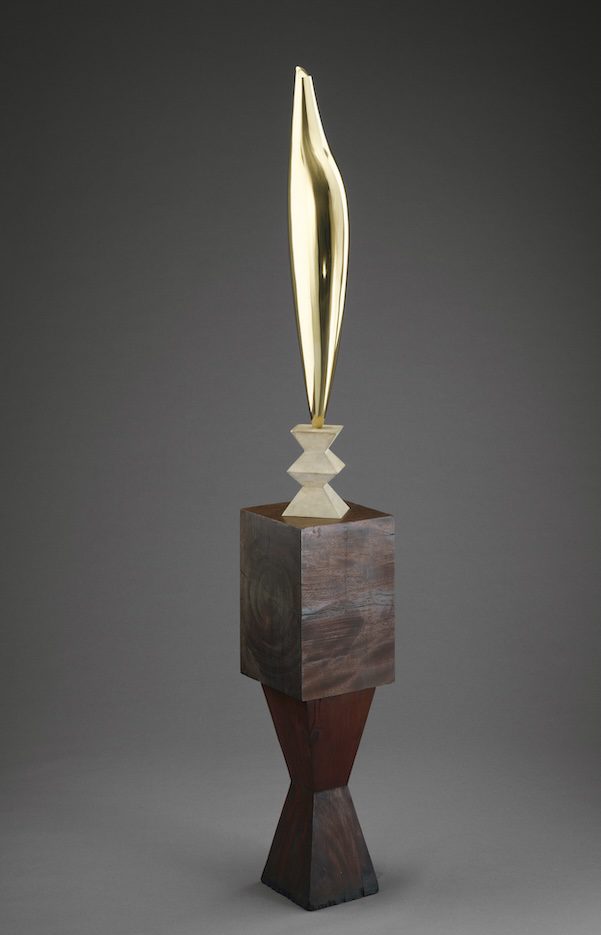
This sculpture represents the apex of Brancusi’s research on the theme of the bird, a subject to which the artist returned obsessively throughout his life. The sleek, tapered form doesn’t depict a specific bird but captures the very essence of flight, the aspiration upward, the desire for transcendence. The golden surface reflects the surrounding environment, making the work seem in constant motion, as if about to take flight. The pedestal, an integral part of the work, amplifies this vertical tension. With Golden Bird, Brancusi demonstrates how sculpture can go beyond representation to embody a pure idea.
This female torso in polished onyx represents one of the most abstract interpretations of the human body in the entire history of sculpture. The form is reduced to a slightly curved column, where femininity is suggested through barely perceptible curves. The choice of onyx, with its natural veining, adds an almost organic dimension to the geometric abstraction. Brancusi manages to evoke the sensuality and vitality of the young body without resorting to any explicit anatomical detail. The work becomes a meditation on growth, vital energy, on the beauty of pure form emerging from raw material.
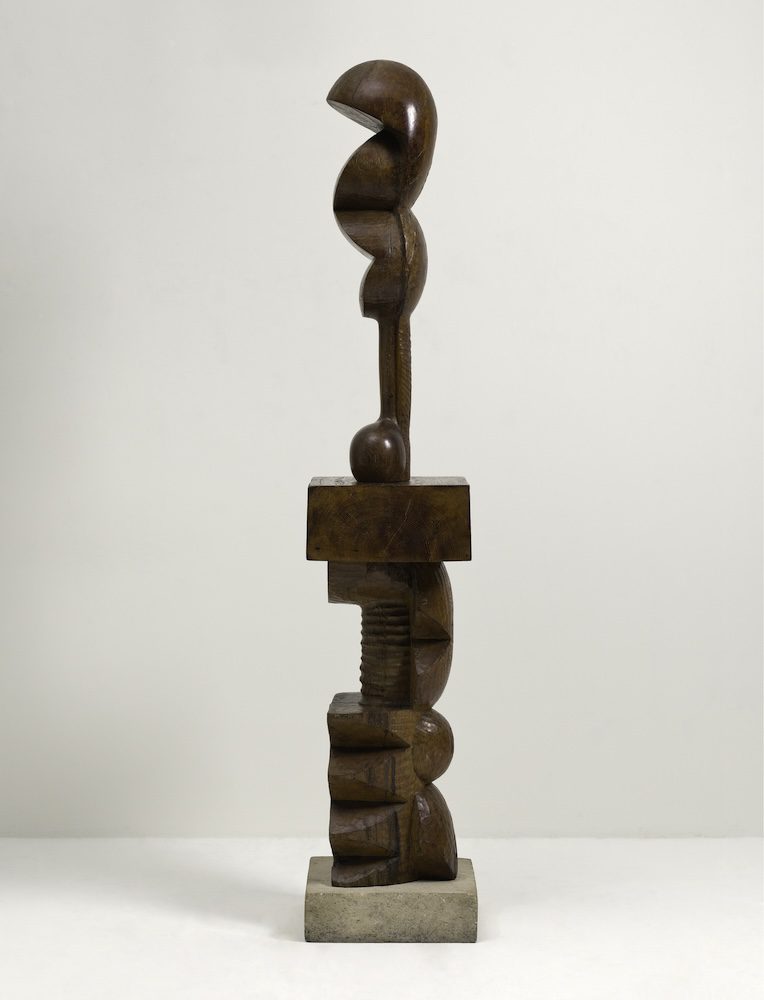
In this sculptural composition, Brancusi reinterprets the myth of creation through his essential formal language. Adam is represented as an elongated form in oak wood, while Eve appears as a more rounded and welcoming form, made of oak and placed in contact with the cement base. The two figures dialogue in space, creating a compositional tension that evokes the primordial relationship between masculine and feminine. The use of wood, a material dear to Brancusi due to his peasant roots, gives the work an archaic and ritual quality. On the other hand, the reference to the technique used by Gauguin during his Tahitian period and to African sculpture is evident. Once again, the artist demonstrates how a few essential lines can contain universal and timeless meanings.
Constantin Brancusi’s legacy continues to resonate in contemporary art. His works remind us that true innovation does not consist in adding, but in removing until reaching the essence, that formal truth that lies at the heart of every representation. Starting January 1st 2027 Constantin Brancusi’s works will enter the public domain in several countries, according to the national legislation, allowing their reproduction without artist’s copyright restrictions. However, a part from other possible third party restrictions and copyrights, the quality of reproductions remains fundamental to do justice to the artist’s extraordinary technical mastery, particularly the polished and reflective surfaces that characterize his sculptures.
Scala Archives has official photographic shots of the artist, his documents and atelier, and his artworks made in direct collaboration with the major museums that house Brancusi’s works, including the Metropolitan Museum of Art, the Philadelphia Museum of Art, the Art Institute of Chicago, the Centre Pompidou, and the Solomon R. Guggenheim Museum. These professional images, created with controlled lighting and specialized photographic techniques, capture with precision the nuances, reflections, and material details that make the artist’s creations unique.
For any type of project which wishes to showcase Brancusi’s genious at its fullest, the maximum fidelity to the original works will be necessary, and the high-quality files available represent the ideal choice. Fill out the request form for more information on research and licensing.
***